Bridging Theory and Practice: Inside the Akij Group Industrial Visit
For students of Industrial and Production Engineering (IPE), textbook theories only truly come alive when witnessed on a massive factory floor.
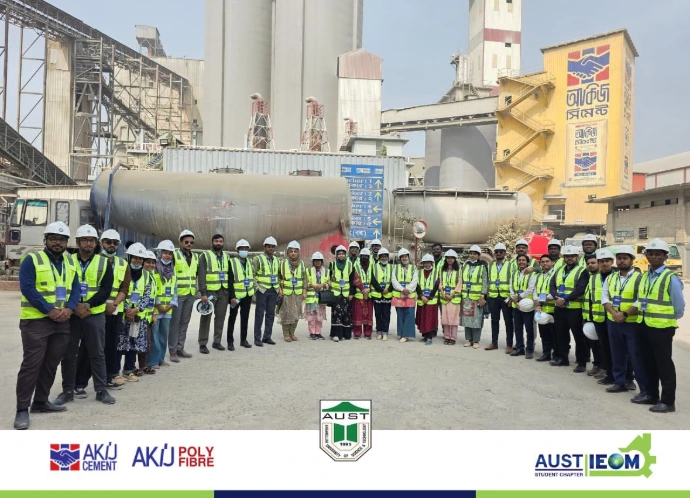
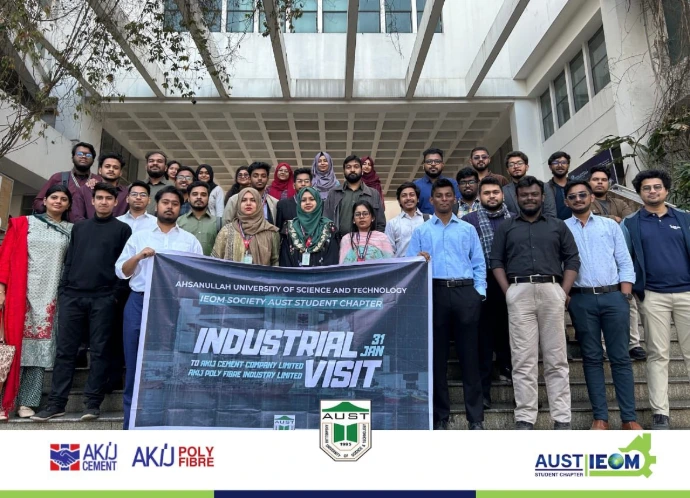
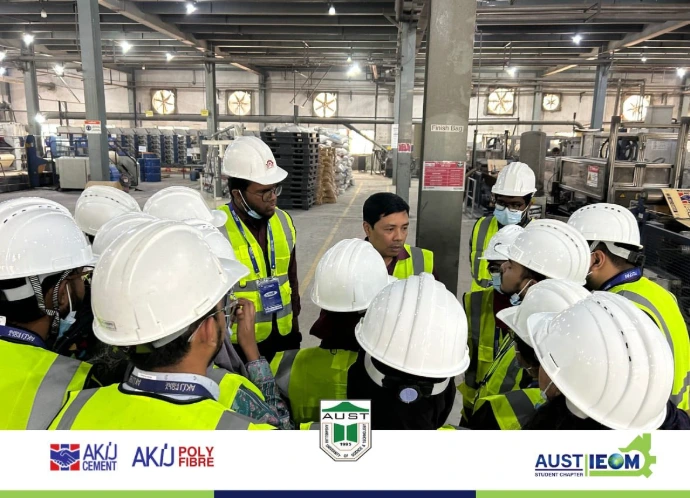
On January 31, 2026, the IEOM Society AUST Student Chapter proudly organized a comprehensive industrial visit to Akij Cement Company Ltd. and Akij Poly Fibre Industries Ltd. Months of careful planning, contacting company officials, and coordinating with university faculty culminated in this incredible opportunity for our students to see large-scale industrial operations up close.
Here is a look at what we learned by stepping out of the classroom and into the heart of practical manufacturing.
Exploring Advanced Cement Production at Akij Cement
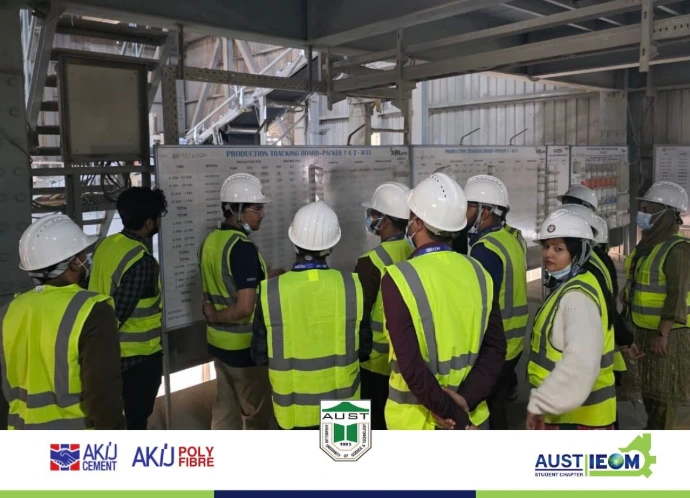
Our first stop was Akij Cement Company Ltd., where students observed the complete, end-to-end cement production cycle. The tour covered everything from raw material handling to clinker production, grinding, and final packaging.
A major highlight of this segment was learning about their fly ash-free cement, which is engineered to offer superior strength and durability. Furthermore, company experts provided a detailed breakdown of the Vertical Roller Mill (VRM) system.
Witnessing the VRM technology in action was fascinating, as it is a modern, highly energy-efficient system that seamlessly combines grinding, drying, and material separation into a single, optimized process.
The Packaging Process at Akij Poly Fibre
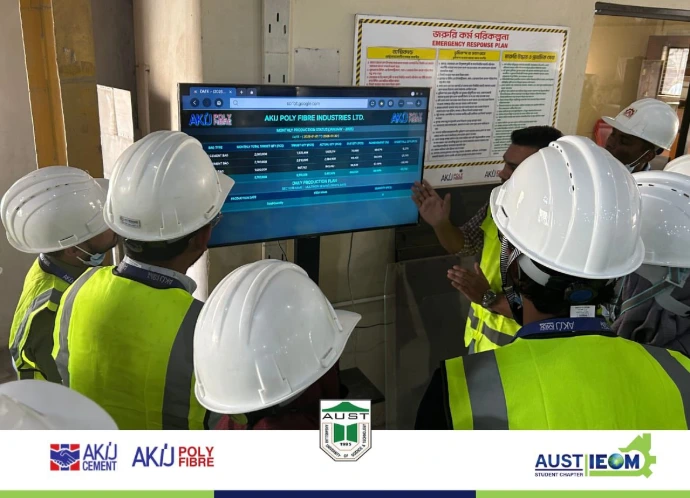
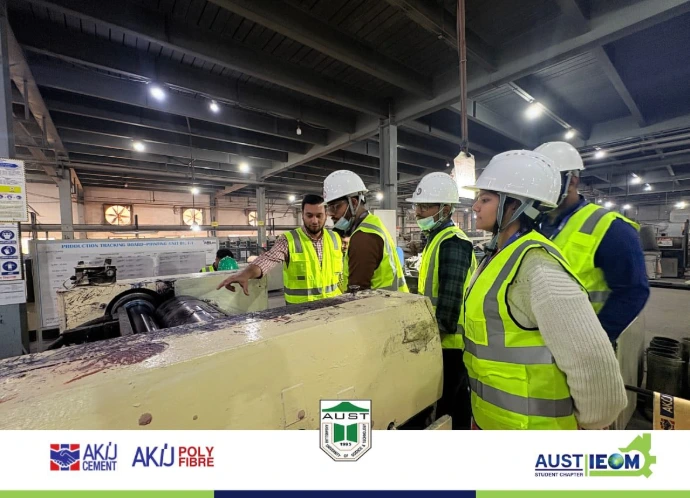
Next, the delegation moved to Akij Poly Fibre Industries Ltd. to observe a crucial, yet often overlooked, part of the supply chain: the production of polypropylene woven cement bags.
Students walked through every stage of the manufacturing process:
Extrusion: Melting raw granules into durable threads.
Weaving & Cutting: Transforming threads into the woven fabric of the bags.
Stitching & Quality Inspection: Ensuring the final product can withstand the heavy weight of cement.
The facility's high level of automation and rigorous quality control measures were put on full display. We also received an insightful explanation of the structural differences between 1-ply and 2-ply bags, focusing specifically on how those differences impact load-bearing strength.
Connecting the Supply Chain
More than just observing isolated factories, this visit helped students visualize how complex industrial processes are integrated and optimized. Seeing how the Poly Fibre packaging unit directly coordinates with the Cement manufacturing unit provided a real-time lesson in supply chain management.
Accompanied by our dedicated faculty members, who expertly linked the factory floor operations back to our academic syllabus, this trip proved to be an invaluable learning experience. It is initiatives like these that truly connect theory with real-world industry practices, preparing our IPE students for their future careers.
At 𝐀𝐤𝐢𝐣 𝐂𝐞𝐦𝐞𝐧𝐭 𝐂𝐨𝐦𝐩𝐚𝐧𝐲 𝐋𝐭𝐝. students observed the entire cement production process, from raw material handling to clinker production, grinding, and packaging. They learned about fly ash-free cement, which offers better strength and durability. The visit also included a detailed explanation of the Vertical Roller Mill (VRM) system, a modern and energy-efficient technology that combines grinding, drying, and material separation into one process.